
Adaptive Pricer
Adapt prices in real time using AI that learns from context, customer behavior, and market signals—no historical data required.
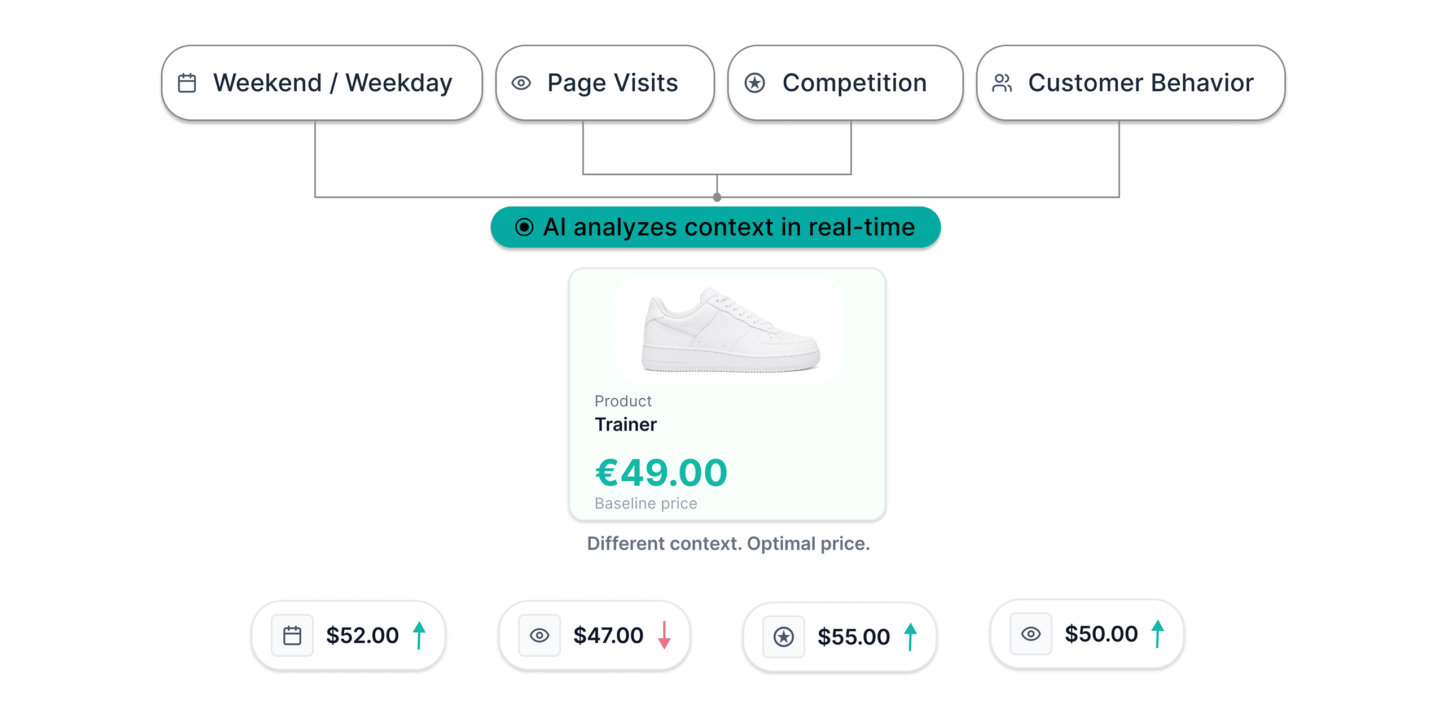
How Adaptive Pricer Responds to Real-Time Market Context
Markets don’t behave the same way all the time—customer behavior changes by moment, channel, and context. The Adaptive Pricer uses AI to continuously learn from real-time signals and adjust prices dynamically, ensuring your strategy adapts to every situation without relying on historical data.
-
Context-Aware Pricing Decisions
Adjust prices based on real-time signals like traffic, conversion rates, competitor changes, and timing
-
No Historical Data Required
Start optimizing immediately—even for new products—by learning directly from live customer behavior
-
Continuous Learning & Adaptation
Test, learn, and refine pricing decisions automatically as market conditions evolve
-
Align Pricing to Customer Behavior
Adapt prices to different segments, buying patterns, and engagement levels to maximize performance
DynamicPricing AI gave us the ability to react to market changes in real time. We saw a measurable revenue uplift within the first month of going live.
MOST RELEVANT KPIs
Understand your business looking at some numbers
-
+16% Conversion Rate Uplift
Conversion Performance
Increase purchases by adapting prices to real-time customer behavior and context.
-
+13% Revenue per Visitor
Revenue Efficiency
Generate more revenue from the same traffic with context-aware pricing
-
+9% Pricing Responsiveness
Market Adaptability
React faster to changes in demand, competition, and customer engagement
-
-40% Time to Optimization
Learning Speed
Achieve optimal pricing faster without relying on historical data.
FAQ - Adaptive Pricer
-
Adaptive Pricer is an AI-driven pricing model that adjusts prices in real time based on contextual signals like traffic, conversion rates, competitor pricing, and timing factors.
-
Price testing focuses on finding the best price through experimentation, while Adaptive Pricer continuously adjusts prices based on real-time context and behavior without fixed experiments.
-
No. The model learns on the go by testing prices, observing customer responses, and continuously improving decisions based on live data.
-
It uses signals such as page visits, conversion rates, time-based factors (like weekdays or holidays), competitor pricing, and customer behavior patterns.
-
It works best for products with dynamic demand, strong traffic, or context-sensitive performance—such as new launches, impulse purchases, or products influenced by timing or competition.
-
Yes. You can define guardrails like minimum and maximum prices, margin thresholds, and pricing ranges to ensure the model operates within your business rules.
-
The model needs sufficient interaction data to learn effectively. For low-traffic or slow-decision products, results may take longer or be less reliable.
Schedule A call with our team!
Talk to an ExpertGet in touch with a Dynamic Pricing AI representative
Please fill out the form and we will contact you back with more details.