
Automated strategies tailored to your pricing needs
Access 20+ built-in and customizable rules designed to handle virtually any pricing scenario

Execute your best pricing logic on the fly with dynamic pricing rules
Save time and utilize the pricing rules that match your business logic and perform repricing actions without the need for an IT team
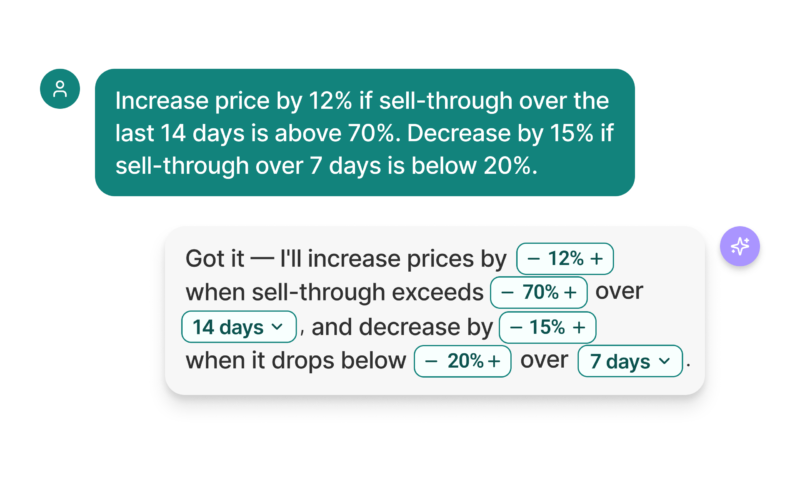
Demand-Based Pricing Rules
Rules to maximize revenue and adapt instantly to market demand
- Sales velocity and conversion rate
- Page views and traffic surges
- Search volume trends
- Seasonal and event-driven demand changes
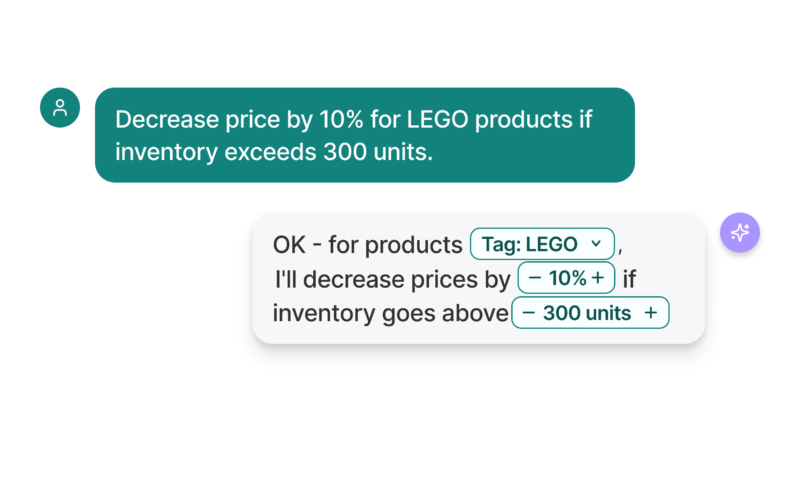
Inventory Pricing Rules
Automate intelligent price adjustments to clear excess stock, protect margins, and sell smarter every day.
- Define your inventory conditions
- Set your pricing actions
- Schedule and activate rules
- Stay in control with built-in guardrails
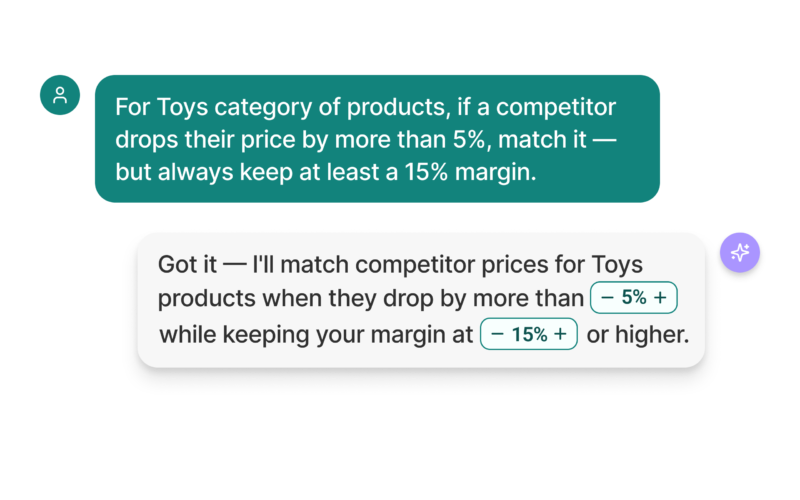
Competition Pricing Rules
Stay competitive while protecting your margins.
- Identify key competitor signals
- Set smart rules and guardrails
- Automate and continuously optimize
- Choose to match, undercut, or stay above competitors
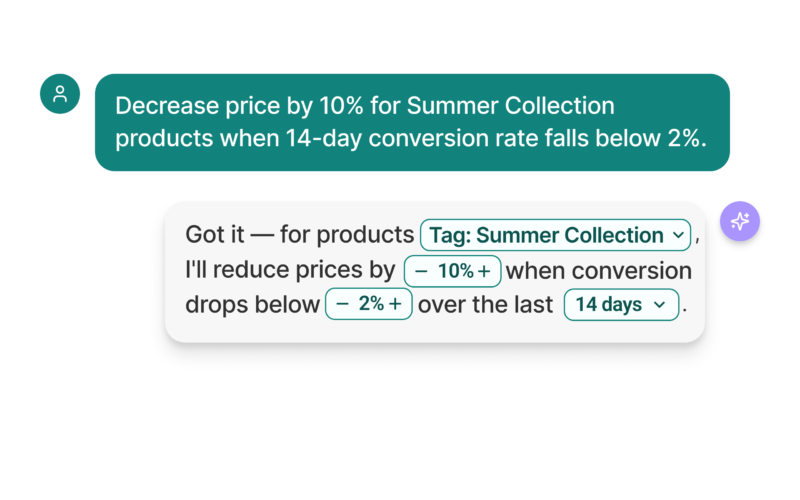
Conversion Rate Pricing Rules
Rules to improve conversion and protect margin by reacting to:
- Conversion trends over time
- High traffic, low conversion products
- Strong performers with margin upside
- Post-price-change performance
How it works
-
Connect your store
Install the app and grant access in minutes. We sync your full product catalogue — no CSV uploads or developer work required.
-
Set your pricing strategy
Choose from AI recommendations or define your own rules — by category, margin floor, competitor gap or demand signal.
-
Launch & monitor
Approve changes individually or let automation run. Every update is logged so you always know what changed and why.
-
Optimise over time
A/B test price points, review uplift reports and fine-tune rules as your business evolves. The system learns from every result.
FAQ - Dynamic Pricing Rules
-
The Dynamic Rules module is a rule-based automation engine designed to optimize product pricing in real-time.
It replaces manual pricing efforts by using definable variables and Key Performance Indicators (KPIs) to make instantaneous, logic-driven price adjustments.
-
Rules can be triggered by a wide range of data points. Key variables include Inventory Levels (stock availability), Engagement Metrics (page visits and traffic), Competitor Data (landscape changes), and Performance Metrics (product sell-through rates).
-
Yes. The platform includes several "out-of-the-box" standard rule types, including:
Cross-Country/Currency: For international sales currency conversion.
Markdown Strategy: For clearance or end-of-life items.
Return Product Pricing: Rules for open-box inventory.
Shipping Rules: Adjustments based on fulfillment costs. -
You can use Segmentation Tags within the Rule Editor. "Inclusion Tags" define the scope of the policy (e.g., specific categories), while "Exclusion Tags" allow you to create exceptions to the rule to handle nuanced scenarios without creating entirely separate rules.
-
Using the Cross-Country rule, the system automatically converts currency for international sales. It can also apply percentage adjustments based on the specific economic value of the target region.
-
Yes. The Policy Editor includes Rounding Rules. After the system calculates the price based on your logic, it applies your formatting preference, such as "Round down to the nearest .99."
-
Subset rules are conditionals that must be met for a specific pricing action to trigger.
For example, you can set a rule that says, "Only apply this price increase if the current profit margin is negative." -
Yes. The system includes Margin Guards, which allow you to establish hard "floors" and "ceilings" for price adjustments.
This ensures that the automation never sets a price outside of your approved range, regardless of the calculation result. -
Yes. While the system is designed for end-to-end automation, Manual Levers are available to allow users to make ad-hoc adjustments when needed.
-
The frequency is customizable based on your business strategy. You can define specific Frequency Settings to determine how often the system scrapes data and recalculates prices, ranging from hourly to monthly.
-
The Calculations Dashboard serves as the central hub for review. It provides visibility into metrics such as Profitability (identifying negative profit items), Price History (comparing Old vs. New prices), Competitive Analysis, and cost-to-price Differentiation.
-
We recommend a consultative, phased approach. It is best to test new policies on a limited product subset first to validate the results and ensure they meet your goals before expanding the automation to your full product catalog.
Schedule A call with our team!
Talk to an ExpertGet in touch with a Dynamic Pricing AI representative
Please fill out the form and we will contact you back with more details.