
Demand‑based Multipricer
Optimize prices across your catalog with AI that balances revenue growth and profitability based on real demand.
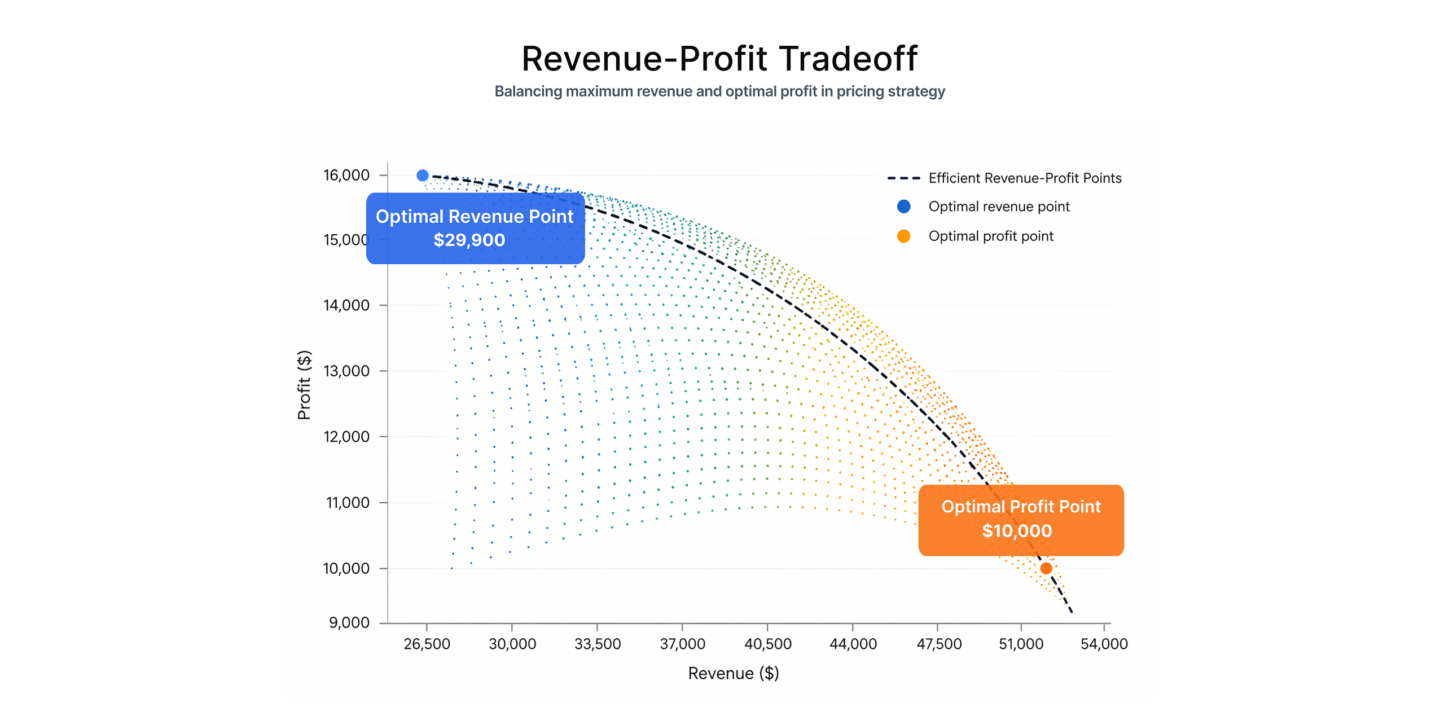
How Demand-based Multipricer Optimizes Revenue and Profit at Scale
Pricing isn’t just about individual products—it’s about balancing performance across your entire catalog. Some products drive volume, others drive margin. The Demand-based Multipricer uses AI to analyze demand and optimize prices across segments, helping you achieve the right balance between revenue growth and profitability.
-
Optimize Revenue–Profit Trade-offs
Evaluate multiple price points and choose the optimal balance between revenue growth and profit margins
-
Portfolio-Level Pricing Strategy
Set targets at category or segment level and align pricing across your entire product mix
-
Dynamic Demand-Based Adjustments
Continuously update prices as demand shifts, ensuring your strategy stays relevant in changing markets.
-
Built-In Business Guardrails
Apply constraints like margin thresholds, competitor benchmarks, and price rules to stay in full control
DynamicPricing AI gave us the ability to react to market changes in real time. We saw a measurable revenue uplift within the first month of going live.
MOST RELEVANT KPIs
Understand your business looking at some numbers
-
+17% Revenue Growth
Revenue Performance
Increase total sales by optimizing prices across your product portfolio
-
+11% Profit Improvement
Profit Optimization
Maximize margins by balancing pricing decisions across different product segments
-
+14% Pricing Efficiency
Portfolio Optimization
Improve overall pricing performance by aligning products to strategic roles
-
-30% Manual Pricing Effort
Operational Efficiency
Automate complex pricing decisions across large catalogs with AI
FAQ - Demand-based Multipricer
-
The Demand-Based Multipricer is an AI-driven pricing model designed to optimize e-commerce prices by analyzing the trade-offs between revenue and profit. It evaluates a range of possible price points to determine the optimal set of prices that align with your specific business goals, such as maximizing transaction volume or increasing margin.
-
The model allows you to position products strategically based on your goals. For example, you can configure the model to maximize revenue for high-traffic “traffic builders” (like TV sets or basic jeans) to acquire customers. Conversely, you can maximize profit for niche or complementary items (like accessories or gift sets) where higher margins are sustainable.
-
Efficient revenue-profit points form a curve representing the best possible trade-offs for a product. These points identify price scenarios where you cannot gain more revenue without sacrificing profit, and vice versa. The model constructs this by evaluating numerous price points (e.g., 20 intervals between $6 and $8) to find the optimal balance.
-
At a minimum, the model requires historical sales data at the variant or product level, including units sold, timestamps, and price points. Crucially, the model creates accurate predictions only for products that have historical sales data on at least three different price points.
-
Yes. If COGS data is unavailable, the model can still function by optimizing for Maximum Revenue only. However, to optimize for Profit or a Revenue-Profit Mix, COGS data is essential to calculate margins accurately.
-
For products with sparse data, the model can incorporate optional clickstream or page visit data. This acts as a proxy for customer interest (intent signals) to enhance demand modeling. Additionally, if a specific SKU lacks data, the model can approximate demand using the category average.
-
The model distinguishes between seasonal and non-seasonal items. For seasonal products (e.g., winter jackets), it uses historical sales data from the equivalent season in the previous year. For non-seasonal products, it uses sales data from the preceding calendar month or period.
-
Yes. During the demand forecasting setup, you can include additional data points such as retail-related holidays, special events, and distinctions between weekdays and weekends to refine the demand prediction.
-
You can implement Business Constraints such as Min-Max price boundaries. Furthermore, you can set Margin Guardrails, which ensure that any recommended price maintains a minimum profit margin over COGS, preventing the model from suggesting prices that lead to losses.
-
Yes. The model can import competition data points. You can use competitor minimum, maximum, or average prices to set the lower or upper bounds (business constraints) for your own pricing strategy.
-
You can configure the model with three primary objectives:
Optimal Revenue: Maximizes expected gross sales (optimize 100% for revenue)
Optimal Profit: Maximizes margin (optimize 100% for profit).
Profit-Revenue Mix: Uses a tunable coefficient to balance both, allowing for a strategic middle ground (optimize for 50% profit and 50% revenue, or optimize for 75% profit and 25% revenue) -
Yes. You can select specific segments of your portfolio—such as a Category, Brand, Vendor, or Collection—and apply unique optimization goals to them. That’s the essence of the model – to strategically position segments for profit, revenue or mix.
-
Price updates are determined by the schedule you set. You can select a specific period for re-pricing, at which point the model will re-calculate demand based on the latest data and suggest new prices. It depends on the sales volume, the industry and buyers behaviour. Usually customers change prices with this model once per day.
Schedule A call with our team!
Talk to an ExpertGet in touch with a Dynamic Pricing AI representative
Please fill out the form and we will contact you back with more details.