Price Testing / Price Explorer
Optimize prices in real time with AI-driven testing that learns from customer behavior and converges on the best-performing price.
How Price Testing (AI Price Explorer) Drives Optimal Pricing
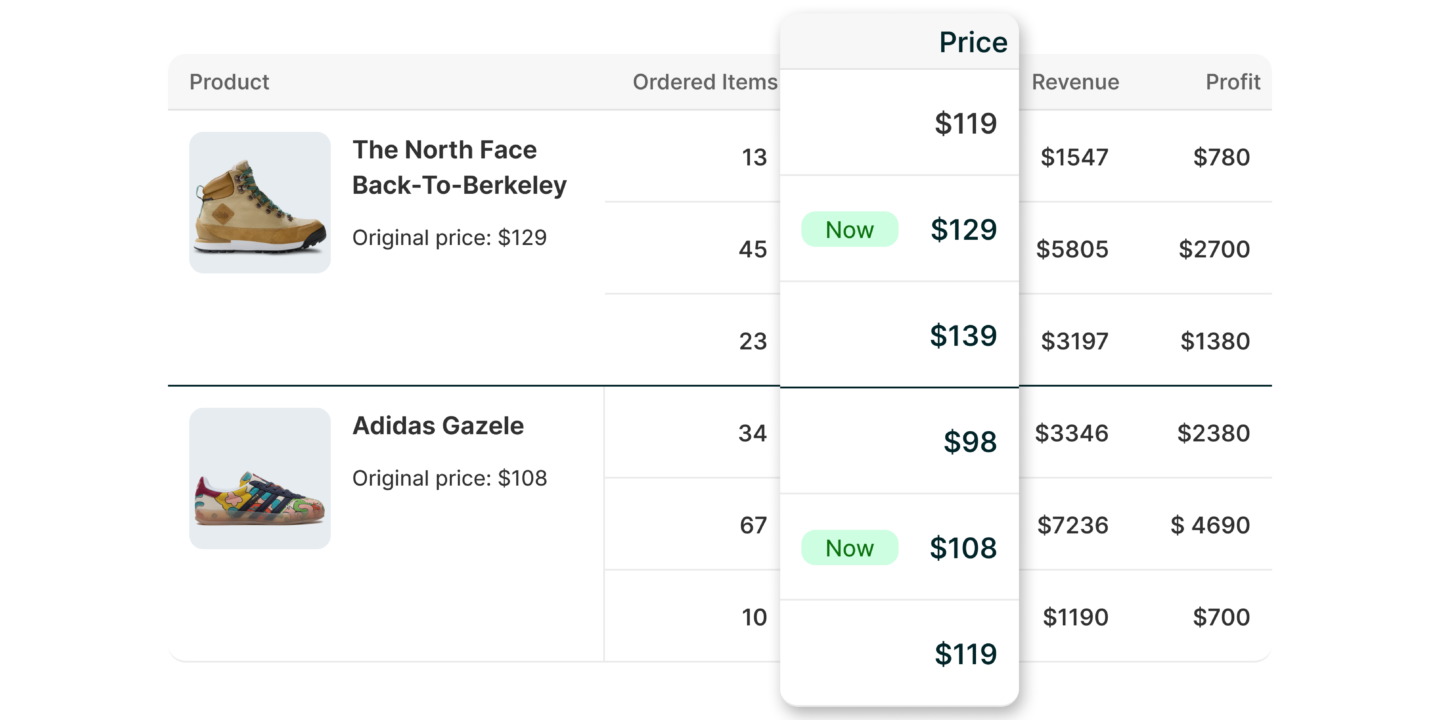
Finding the right price isn’t about guessing—it’s about learning from real customer behavior. Traditional A/B tests are slow and rigid, often missing opportunities. Price Testing uses AI and multi-armed bandit algorithms to continuously learn, adapt, and identify the best-performing price in real time.
-
Real-Time Price Optimization
Automatically shift traffic toward better-performing prices as the system learns from customer behavior
-
Faster Than Traditional A/B Testing
Continuously adapt prices without fixed test periods, accelerating time to the optimal price
-
Demand & Elasticity Insights
Understand how customers respond to different price points and uncover true price sensitivity
-
Revenue & Profit Optimization
Set clear objectives (revenue or profit or mix) and let the AI optimize pricing outcomes within your guardrails.
DynamicPricing AI gave us the ability to react to market changes in real time. We saw a measurable revenue uplift within the first month of going live.
MOST RELEVANT KPIs
Understand your business looking at some numbers
-
+18% Revenue Uplift
Revenue Growth
Increase sales by identifying and prioritizing the best-performing price points
-
+12% Better Conversion Rate
Conversion Performance
Maximize profitability by testing and converging on the most efficient price
-
+10% Profit Lift Optimization
Margin Impact
Maximize profitability by testing and converging on the most efficient price
-
-50% Time to Optimal Price
Learning Speed
Reach the best price faster with AI-driven experimentation and continuous learning
FAQ - Price Testing AI Model
-
Price Testing helps you test higher and/or lower prices safely and see what actually works best for your store — in terms of conversions, revenue, and profit. Everything is learned automatically from real customer behavior, without manual effort or guesswork.
-
Traditional A/B or switchback tests use fixed prices over fixed time periods (for example, one week at €50, the next week at €55).
AI Price Testing works differently:
Prices are tested at the same time, not sequentially
The system learns continuously from real customer behavior
Better-performing prices are shown more often automatically
You don’t have to wait for a test to “end” to see results.
This approach balances learning and revenue performance at the same time. -
AI Price Testing uses a multi-armed bandit model combined with interval-based price rotation. Different price points — including the original price — are shown in controlled time intervals, while the system continuously learns from live performance data.
Based on real results, the model increases exposure to price points that deliver stronger outcomes in conversion, revenue, and profit. This enables continuous optimization, balancing learning and performance without relying on fixed, time-boxed experiments. -
Price testing is most useful when you want to understand how customers react to price changes and find the right balance between margin, volume, and profit. Common scenarios include:
Testing higher prices (margin-focused)
See how much margin you can safely add
Run short high-price experiments
Capitalize on trending or high-demand products
Identify your true pricing ceiling
Testing discounts (volume-focused)
Boost seasonal demand
Clear slow-moving products
Increase order volume without over-discounting
Find the optimal discount level
Exploring multiple price points (Price Testing AI)
Test several price variations at once
Optimize for margin, volume, or both
Compare price sensitivity with small price differences
Learn continuously which prices perform best -
Yes — but only within the boundaries you define.
You control:
Which products are tested
Allowed price ranges (higher / lower limits)
Margin or cost guardrails
When tests start and stop
At each moment you can revert the prices to their original value. Price Testing does not make uncontrolled or irreversible changes. -
There is no fixed “test period”. You have the option to set a timeframe.
The test starts learning immediately and improves continuously as more data comes in. The test can be stopped at any time. -
Early signals often appear within days, sometimes sooner for high-traffic products.
Confidence improves as:
More orders are collected
Traffic volume increases
Price differences become clearer
The system keeps improving the longer it runs. -
Yes, but results will naturally take longer.
Price Testing works best for:
Medium- to high-traffic products
Products with stable demand
Categories where price sensitivity matters
For very low-traffic items, it can still run, but learning will be slower. -
Price Testing is often the first step in structured price testing, helping you understand how customers respond to different price points in a controlled way. Once you build confidence and gather learnings, you can move on to more advanced revenue optimization models, such as Adaptive Pricer or other rule- and context-driven pricing approaches.
These allow you to factor in additional signals — like demand patterns, inventory, margins, or business rules — and explore more complex pricing strategies beyond isolated price tests.
Schedule A call with our team!
Talk to an ExpertGet in touch with a Dynamic Pricing AI representative
Please fill out the form and we will contact you back with more details.