
Switchback Sequential A/B Price Testing for Reliable Shopify Pricing Decisions
In the dynamic world of e-commerce, optimizing pricing is paramount for profitability and growth. Traditional A/B testing often presents challenges, particularly when businesses want to avoid price discrimination among customers while still gathering robust data. This is where switchback sequential A/B price testing for Shopify emerges as an invaluable strategy. It offers a sophisticated, non-discriminative approach to understanding customer willingness to pay and the impact of price changes. For CRO professionals and agencies managing Shopify stores, this method provides a powerful tool to conduct ethical and effective pricing experiments, ensuring all users see the same price at any given time while still isolating the impact of different price points.
Table of Contents
- What is Switchback Sequential A/B Price Testing for Shopify?
- Why is Switchback Sequential A/B Price Testing for Shopify Important for CRO Professionals and Agencies?
- How Does Switchback A/B Price Testing for Shopify Work? (Model Setup)
- Example: Applying Switchback Sequential A/B Price Testing to a Cosmetic Product on Shopify
- Maximizing Your Results with Switchback Testing
What is Switchback Sequential A/B Price Testing for Shopify?
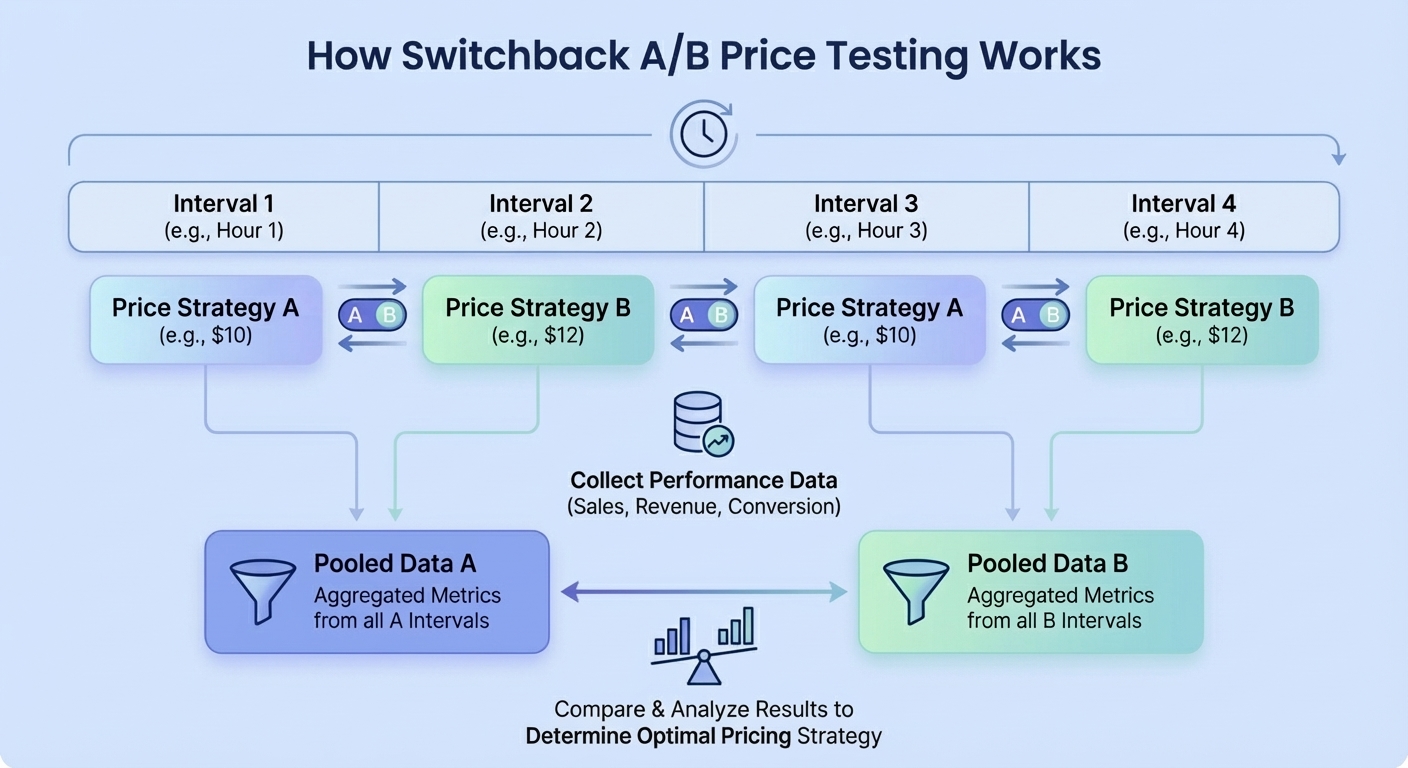
Switchback sequential A/B price testing for Shopify is an advanced experimentation methodology designed for scenarios where traditional A/B testing (splitting users into control and treatment groups simultaneously) is not feasible or desired. Instead of showing different prices to different segments of users at the same time, switchback testing alternates between price A (control) and price B (treatment) for *all* users over defined periods. This sequential switching ensures that every customer experiences the same price at any given moment, thus eliminating price discrimination concerns. The impact of each price point is then measured and compared across these alternating periods, allowing businesses to understand how changes in pricing affect key metrics like conversion rates, revenue, and profit, while maintaining a fair and consistent customer experience.
Why is Switchback Sequential A/B Price Testing for Shopify Important for CRO Professionals and Agencies?
For Conversion Rate Optimization (CRO) professionals and agencies, the ethical and practical challenges of price testing can be significant. Traditional A/B tests that show different prices to different customers simultaneously can lead to customer dissatisfaction, brand damage, and even legal issues. Switchback sequential A/B price testing for Shopify addresses these concerns directly:
- Non-Discriminative Testing: It ensures all users on the Shopify store see the same price at any given moment, upholding fairness and transparency. This is crucial for maintaining customer trust and brand integrity.
- Reduced Contamination: By exposing the entire user base to one price at a time, the risk of “leakage” or users comparing prices across different groups is minimized, leading to cleaner data.
- Accurate Causal Inference: The alternating periods allow for better isolation of the price change’s effect, as external factors (like marketing campaigns or seasonality) are more likely to impact both A and B periods equally, making comparisons more robust.
- Ideal for High-Traffic Stores: Shopify stores with consistent daily traffic can leverage the sequential nature to quickly gather statistically significant data on price elasticity.
- Strategic Advantage: Agencies can offer their clients a sophisticated, ethical, and highly effective method for price optimization, driving better ROI without compromising customer experience.
How Does Switchback A/B Price Testing for Shopify Work? (Model Setup)
Implementing a switchback sequential A/B price testing for Shopify campaign involves several critical steps to ensure accuracy and actionable insights:
1. Campaign Objective
Begin by clearly defining the strategic goal of your experiment. Are you aiming to increase Conversion Rate (CTR), maximize Revenue, boost Profit, or increase the number of Orders? Your objective will guide the metrics you track and the statistical analysis you perform.
2. A/B Calculator
Estimate the required duration for your switchback A/B test. Using an A/B calculator, choose a statistical confidence level (alpha, e.g., 95%) and power (e.g., 80%). Then, based on your objective, enter either baseline & expected treatment conversion rates (for CTR) or the expected difference in means with its standard deviation (for Revenue/Profit/Orders). The calculator will recommend the total number of periods the test should run. Tweak these inputs to understand how changes affect the required duration and iterations.
3. Price Offset
Define the price variations for your test. The price offset can be configured as a percentage (e.g., ±10% from the original price) or an absolute value (e.g., ±$5). Additionally, you can specify price endings such as .00, .49, or .99, which are crucial for leveraging psychological pricing strategies and evaluating their impact.
4. Experiment Duration
Select a specific time range for your price test. The overall duration is heavily influenced by your Shopify store’s traffic volume. Higher traffic allows for shorter durations, while lower traffic requires longer periods to achieve statistical significance. It’s important to balance the need for speed with the need for robust data.
5. Price Plan
Review an illustrative switchback timeline. This preview shows how price A (control) and price B (treatment) will alternate given your chosen start date, overall duration, and desired frequency of switching (e.g., daily, weekly). Each product within the campaign will typically use its own randomized sequence in the live campaign, but this mock plan helps visualize the structure and maximum consecutive periods for each price.
6. When Experiment Ends
Determine the price each product should revert to once the campaign is completed. You can choose to keep the latest price selected by the winning variation or revert products to their original pre-experiment price. This final step is crucial for transitioning from the experiment phase to permanent price optimization.
Example: Applying Switchback Sequential A/B Price Testing to a Cosmetic Product on Shopify
Imagine a Shopify store, “Glow Skincare,” wants to test the optimal price for their new anti-aging serum, “Youth Elixir.” They currently sell it for $49.99 and believe a slight adjustment could increase profit without significantly impacting sales. They decide to use switchback sequential A/B price testing for Shopify.
- Campaign Objective: Maximize Profit.
- A/B Calculator: After inputting their current sales data and an expected 5% difference in profit per sale, the calculator recommends a 4-week test, alternating prices daily.
- Price Offset:
- Control (A): $49.99
- Treatment (B): $52.49 (a 5% increase, maintaining the .49 price ending for psychological appeal).
- Experiment Duration: 4 weeks (28 days).
- Price Plan: The system will alternate between $49.99 and $52.49 daily for all visitors. For example, Monday: $49.99, Tuesday: $52.49, Wednesday: $49.99, and so on.
- When Experiment Ends: Glow Skincare decides that the product should revert to its original price of $49.99 if the test is inconclusive, but if $52.49 proves significantly more profitable, they will adopt that price permanently.
By running this test, Glow Skincare can accurately assess whether the slightly higher price point leads to a net increase in profit, taking into account any potential dip in conversion rate, without ever showing different prices to different customers simultaneously.
Maximizing Your Results with Switchback Testing
While the methodology is powerful, its successful implementation on Shopify requires robust tools. Platforms that specialize in dynamic pricing and A/B testing can automate the complex scheduling, data collection, and analysis required for effective switchback tests. For Shopify merchants, exploring specialized apps is crucial for seamless integration and powerful results.
Understanding and implementing dynamic pricing strategies, including advanced testing methods like switchback A/B tests, can significantly boost a Shopify store’s bottom line. Learn more about how dynamic pricing works on Shopify at Dynamic Pricing on Shopify. For hands-on implementation of advanced pricing strategies and sequential A/B testing on your store, consider integrating a dedicated application like dynamicpricing.ai/ on the Shopify App Store.
Conclusion
Switchback sequential A/B price testing for Shopify offers a sophisticated and ethical solution for businesses seeking to optimize their pricing strategies without resorting to price discrimination. By systematically alternating prices for all users over time, this method provides invaluable insights into customer behavior and price elasticity, making it an indispensable tool for CRO professionals and agencies. Its ability to deliver clean, actionable data while maintaining a consistent customer experience positions it as a superior approach for informed decision-making in the competitive e-commerce landscape. Embrace switchback testing to unlock your Shopify store’s full revenue potential.