Set a price range. Let AI do the rest
Scale your current revenue and margin levels with automated pricing processes
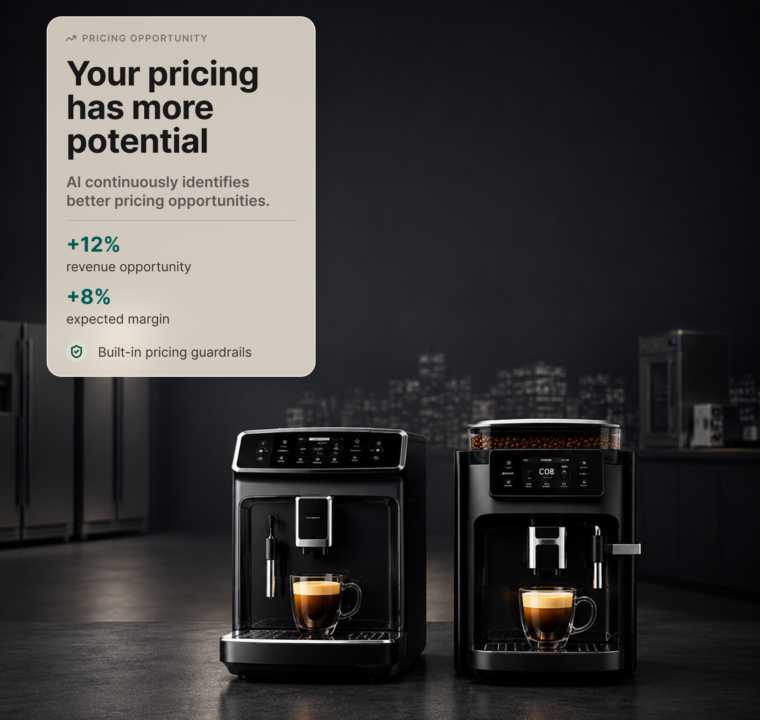
Faster exploration and longer optimal play
Leverage data from orders, inventory, customer behavior and competition to train the AI models
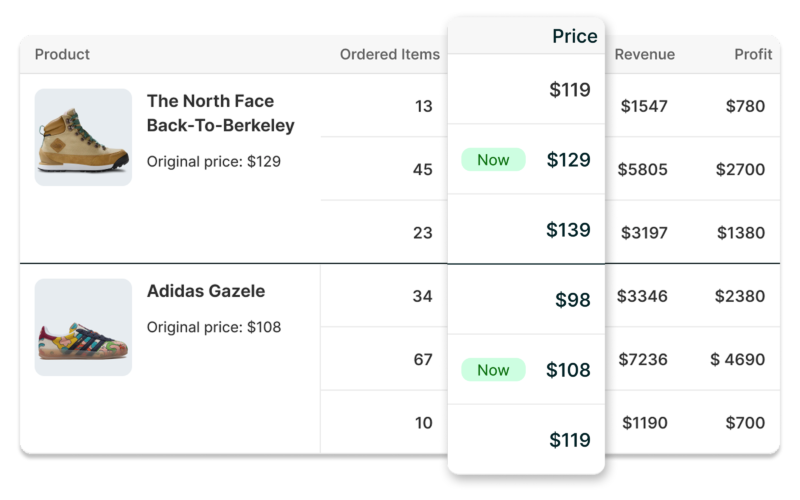
Price Testing
Out-of-the-box AI pricing models that pull in demand analytics to optimize prices immediately!
- Run Bayesian A/B price tests with confidence
- Price experiments - from tests to AI optimization
- Understand demand response and price elasticity
- Automate value-based pricing decisions
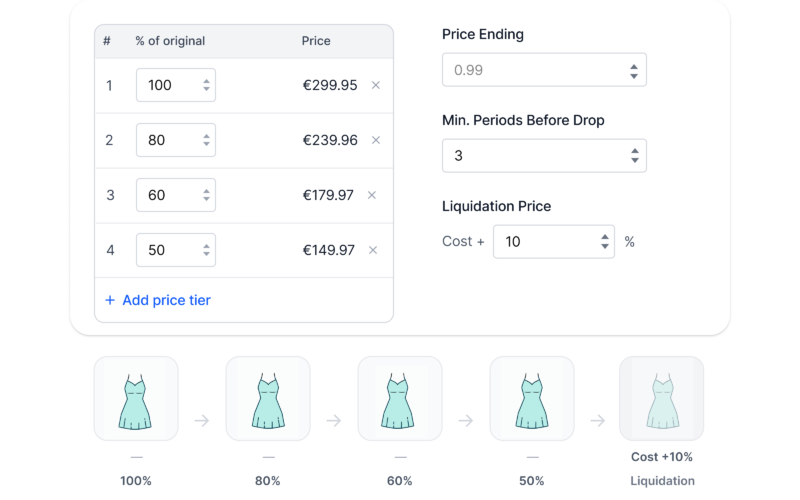
Markdown Inventory Optimizer
Continuously learns from inventory & demand to optimize pricing & markdown timing, maximizing revenue and clearing stock efficiently
- Use demand signals to guide gradual, strategic price reductions
- Optimize markdown timing to boost revenue and turnover
- Reduce holding costs through efficient stock clearance
- Factor in marketing and acquisition costs
Adaptive Pricer
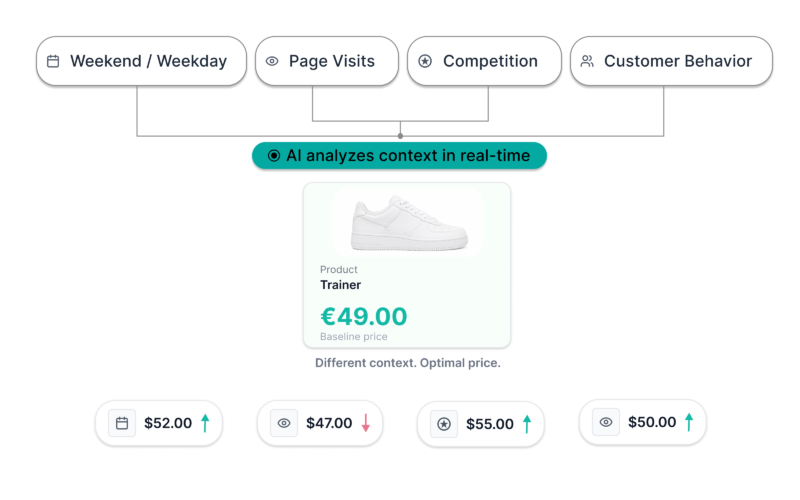
Dynamically adjust prices in real time using contextual signals to maximize performance across changing market conditions
- Adapt pricing to traffic and conversion signals
- Respond to seasonality, holidays, and day-of-week trends
- React to competitor price changes automatically
- Personalize pricing by customer segments and behavior
Demand-based Multipricer
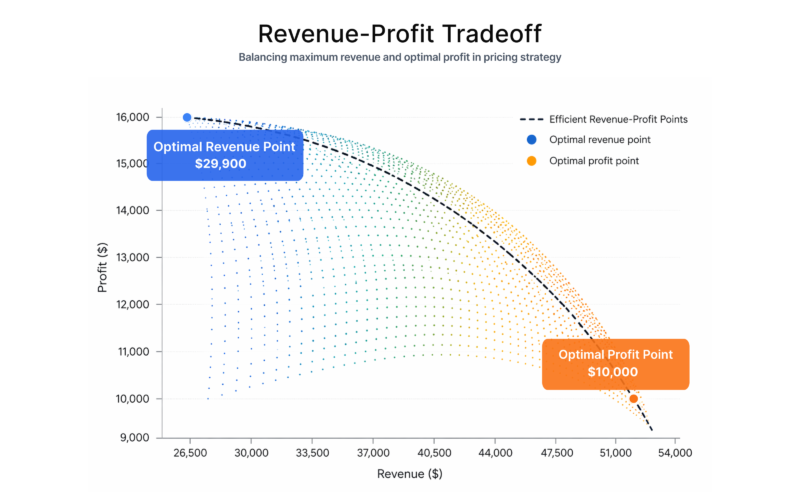
Optimize prices across your catalog by balancing revenue growth and profitability with demand-driven intelligence
- Balance the revenue–profit tradeoff
- Set revenue and profit targets by category
- Automatically adjust prices as demand changes
- Apply guardrails like margins, benchmarks, and rounding
How it works
-
Connect your store
Install the app and grant access in minutes. We sync your full product catalogue — no CSV uploads or developer work required.
-
Set your pricing strategy
Choose from AI recommendations or define your own rules — by category, margin floor, competitor gap or demand signal.
-
Launch & monitor
Approve changes individually or let automation run. Every update is logged so you always know what changed and why.
-
Optimise over time
A/B test price points, review uplift reports and fine-tune rules as your business evolves. The system learns from every result.
FAQ - AI Pricing Models
-
Several of our models utilize the Bandit framework, a form of fast reinforcement learning. This allows the AI to "learn" the optimal price by balancing exploration (testing new prices) and exploitation (sticking to the best-performing price) based on real-time market signals.
-
The models are optimized for established merchants who handle a significant volume of orders and transactions. The algorithms rely on data flow to make accurate decisions, making them less suitable for low-volume stores.
-
No. All our models are sequential, meaning they do not discriminate between buyers. At any given moment, every customer sees the exact same price. The price changes over time based on demand and strategy, but not based on the specific user visiting the site.
-
It depends on the specific model you choose. Some models require historical data to analyze past price-volume relationships, while others are designed to work from a "cold start" and learn from current experience.
-
If you are launching new products or lack past data, you can use the Price Testing and Adaptive Pricer. These models use reinforcement learning to learn from experience in real-time.
-
The Demand-based Multipricer and the Markdown Inventory Otimizer require historical price-volume data. They analyze past performance to calculate the next-best prices for revenue or profit optimization.
-
All models include strict guardrails to protect your business. You can define Min-Max prices and set Margin Guards to ensure that prices never drop below a profitable threshold or exceed a competitive ceiling.
-
Yes. There is a comprehensive Activity Log that tracks every single price change. It provides full transparency into how the model is behaving.
-
All price changes are saved within the system. You have the ability to revert changes if necessary, giving you full control over the final output.
-
Yes. The Activity Log records who from the merchant side created the instance of the model, providing accountability for internal teams.
-
The Price Explorer is designed to discover optimal prices through experimentation (learning from experience), making it ideal for new items.
The Demand-Based Multipricer relies on analyzing existing historical data to find the efficient frontier between revenue and profit. -
The Stock Optimizer uses reinforcement learning to adjust prices based on inventory levels and sales velocity.
It is ideal when your primary goal is managing inventory turnover or clearing stock while maximizing return. -
The Markdown Runner uses historical data to determine the most effective path for discounting products.
It is generally used for end-of-life products or seasonal clearance to maximize revenue before inventory is depleted. -
Yes. When setting up a model instance, you can define when it starts and how long it will operate.
Once the duration expires, the model stops adjusting prices automatically.
Schedule A call with our team!
Talk to an ExpertGet in touch with a Dynamic Pricing AI representative
Please fill out the form and we will contact you back with more details.